

If you spend any time hunting Parks on the Air® (POTA) stations or scrolling through activation reports, you’ll notice two very different approaches: the “turn it up to 100 watts and let’s get this done” operator and the “QRP Zen masters” who bring five watts, a wire, plus enough calm and focus to power an all-day activation. The power debate isn’t quite as heated as digital vs. analog or which antenna is best, but it’s close. Everyone has an opinion.
The best choice depends on the three P’s: priorities, power, and patience.
100 Watts: The Power Play
A 100-watt radio is not “high power”—it’s really just mid-range. But in POTA terms, it’s like bringing a mini dozer to a job where a shovel might work. When you’re running 100 watts, your signal travels farther and punches through band noise more easily than at QRP levels. That means you’ll rack up those 10 contacts quickly—often within minutes—especially on the popular bands like 20 and 40 meters.
Power POTA doesn’t care if the solar numbers are terrible, the band is noisy, or the trees are trying to eat your antenna. A 100-watt rig gives you some leeway. When propagation goes sideways, you can still be heard. It’s better for operating under difficult conditions.
When it comes to signal readability, five watts SSB is not the same as five watts CW. If you’re primarily an SSB activator, 100 watts dramatically improves your odds of being heard by hunters whose noise floor may be S7 thanks to the chainsaw-carving competition happening next door.
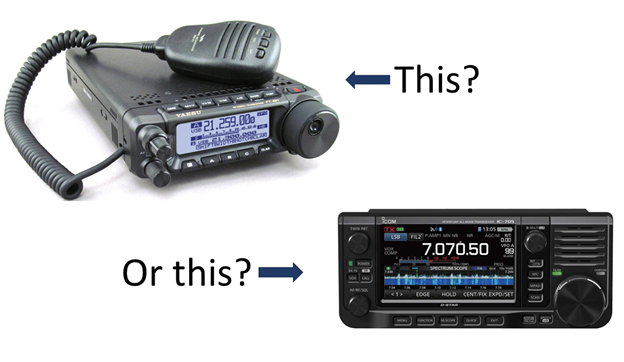
It’s also an excellent compromise for hikers. Many modern 100-watt rigs—like the IC-7300, FT-891, and IC-706 family—are compact enough to bring along in a backpack if you’re doing a short hike rather than a mountain expedition. For example, the case of the FT-891 is 6.1″ x 2.0″ x 8.6″ and weighs a little over four pounds.
But there is a price to pay for the extra power. You’ll need a larger battery, and large batteries are heavy. Some radios want 20A+ on transmit, which will consume power more quickly.
Also, 100-watt radios may mean extra cables, a tuner, and sometimes even a little table, so there’s even more gear to carry. And there’s the potential for RFI. Nearby park-goers with Bluetooth speakers may suddenly start hearing your QSOs.
QRP: The Minimalist Mode
For many hams, POTA is QRP. The idea of grabbing a tiny radio, tossing a bit of wire in a tree, and seeing what propagation offers is appealing—light, minimalist, simple. POTA with a KX2, KX3, FT-818, FTX-1FIELD, or TX-500 is essentially an afternoon hike with a radio attached. Batteries are tiny. Antennas can be light end-fed wires or whips. Your entire station might weigh less than the user manual for an FT-991A.
There’s more battery life, less fuss. QRP radios sip power—you can run an FT-818 all afternoon on a small lithium pack. Many QRP rigs have built-in tuners, built-in batteries, and built-in everything else you could need.
QRP presents a unique challenge and offers bragging rights. Making QSOs on five watts (or even less) feels different. There’s joy in knowing you worked a pileup from a picnic table using power roughly equivalent to a Christmas tree bulb.
It’s also perfect for CW and digital operators. Modes like CW, FT8, and PSK31 make low-power contacts far more achievable even when conditions aren’t great.
But there are downsides to QRP. Five watts works but is not always fast. Some activations take 30-60 minutes to get rolling at a decent pace, especially on voice. Propagation can make or break your day. If the band collapses, QRP signals are drowned out by the noise floor.
QRP SSB is an exercise in patience. Many hunters can’t hear you unless they have excellent antennas—and good ears.
Can You Hear Me Now?
From an RF engineering standpoint, the “best” power level for POTA depends on the entire picture, not just the wattage. Power matters, but so do noise floors, antenna efficiency, propagation, and the receiving station’s capabilities. Let’s break it down piece by piece.
Transmit Power Difference
The difference between QRP 5W and 100W is:
- 100W = +20 dBW
- 5W ≈ +7 dBW
This gives the 100-watt station a 13 dB advantage. A 13 dB increase means:
- About 20 times more power is delivered to the antenna.
- The signal is about 2+ S-units stronger (assuming 6 dB/S-unit and typical receivers).
This alone is enough to shift a marginal contact into a copyable one. Adding 13 dB of transmit power does not change propagation—it simply raises your signal above the band noise and QRM more consistently.
Receiving Noise Floors
QRP struggles primarily because of other people’s noise floors, not because five watts doesn’t get out. Typical HF noise floors:
- Suburban: S5-S7
- Rural: S2-S4
- Remote site: S1-S2
To copy a QRP SSB signal reliably, you generally need:
- SNR of 6-10 dB for good voice intelligibility
- CW requires far less, ≈3 dB depending on the filter
- FT8 requires even less, ≈–20 dB or lower
If your five-watt signal arrives 4 dB above the noise in a rural location, great. If it arrives 4 dB below the noise floor in a suburban location, 100 watts would have fixed that problem.
Antenna Efficiency & Height
Inefficient portable antennas put QRP at a disadvantage. Typical POTA varieties like end-fed half-waves (EFHW), random wires, loaded verticals, and compromise antennas often have:
- Slight mismatch losses (≈1-2 dB)
- Ground losses (2-8 dB)
A 3-6 dB antenna loss in portable work is trivial with 100 watts but significant with QRP. An example:
- 5W with 6 dB loss delivers only 1.25W ERP (effective radiated power).
- 100W with 6 dB loss still delivers 25W ERP.
You don’t need an electrical engineering degree to predict which one gets spotted first.
Methods for improvement include elevating the antenna, using tuned elevated radials for verticals, and making a counterpoise for EFHW/random wires. The most effective strategy for ground-mounted antennas is to get the current peak away from the lossy earth.
Mode Efficiency
This is where QRP shines—with the right mode, of course:
- SSB is workable but marginal during poor conditions. It’s sensitive to SNR and QRM and needs up to 10 dB SNR (signal-to-noise ratio) for a solid copy.
- CW has about 3-6 dB better performance than SSB. Narrow filter bandwidth increases SNR.
- Digital modes (FT8, FT4, JS8Call, et al.): FT8 works at around -20 dB SNR and often performs equivalent to 50-100W SSB.
Propagation Variability
When propagation is stable, QRP works impressively well. QRP CW or FT8 can make coast-to-coast contacts with 1-2 watts. When propagation collapses, QRP is the first to suffer.
Think of power as a hedge against fading. More watts = more fade protection.
Which One Should You Use?
It depends on your operating style. If you want fast, reliable activations or you primarily operate SSB, choose 100 watts. If you mostly do drive-up POTA and don’t mind a slightly bigger battery, 100 watts also wins. A 100-watt rig in the car gives you fast, dependable activations.
If you operate primarily CW or digital, both QRP and 100 watts work great, but QRP is extremely fun and more portable. If you hike long distances or activate summits and believe that less is more, it’s a no-brainer—QRP. A QRP field kit is lightweight, convenient, and usually won’t break the bank.
Don’t forget—just about all 100-watt radios have power adjustments. If you’re in the mood for QRP, open the menu and set to five watts. Or you can set it to 20 watts for a little more punch. Going from 1 to 100W is as simple as changing the setting.
The truth is that many experienced activators use both. It doesn’t have to be an either/or decision. Use what suits the day, the park, the conditions, and your mood.
So, should you use QRP or 100 watts for POTA?
Yes.

