

We aren’t getting any younger—according to the ARRL, the average age of ham members is 68. It’s likely many of us are retired and will eventually consider downsizing. This might mean a move to a smaller space such as a condo, apartment, retirement community, or assisted-living facility.
For many amateur radio operators, moving into a retirement community doesn’t mean giving up the hobby—it just means getting creative. Antennas shrink, rigs get quieter, and operating habits adapt to new surroundings. But the joy of chasing DX, joining nets, and tinkering with gear remains very much alive. Some seniors find that ham radio is now even more important. It keeps the mind sharp, provides an instant social network, and offers a sense of independence.
Here’s how hams can continue to operate successfully in these settings and solve the unique challenges that come with them. Those who currently live under the thumb of HOAs, zoning restrictions, and apartment/condo restrictions may also find some helpful information here, even if you’re not a senior yet.
The Rules Rule
The biggest hurdle in senior communities isn’t RF noise, limited mobility, or even lugging a power supply down the hallway—it’s the rules. Most assisted-living and retirement centers have guidelines about:
- What can be installed on balconies or patios
- Modifications to walls, windows, or building exteriors
- Noise levels (both human and electronic)
- Safety and trip hazards
- Use of personal electronic equipment that may interfere with other devices
Some communities are restrictive, while others are surprisingly ham-friendly. Many don’t know anything about amateur radio, so you may need to do a little educational outreach by showing how the hobby can be beneficial in this setting.
Explain safety. Emphasize that ham radio equipment is FCC-licensed, safe, and not likely to interfere with medical equipment (modern hospital-grade gear is designed with strong EMI shielding). It won’t interfere with modern pacemakers or CPAP machines. It’s also likely that hams will contribute considerably less RFI than the existing fluorescent lights, HVAC systems, motorized beds, lift chairs, and consumer electronics. We’re used to adding proper grounding, chokes, and avoiding “wall warts” whenever possible.
Explain ham radio when asked questions, even the dumb ones. Your neighbors need to know. “No, Gladys, I can’t order takeout with this. Yes, I could talk to Australia. No, I’m not spying on you.”
Benefits include supporting emergency communications, community outreach, and resident education programs. Just think–you can sponsor antenna building instead of the usual arts and crafts.
Amateur radio is a reliable method of communication in emergencies. Our motto is: “When all else fails.” Amateur radio does not depend on infrastructure like cell phone towers, phone lines, or internet connections. A modest AC generator or batteries keep us on the air.
Antennas: Think Possible
Antennas are essential to ham radio, so installing them in senior communities requires a bit of ingenuity. It’s unlikely you’ll be able to erect a 40-foot tower, but you can still get on the air. Decide on your operation style (in-unit, balcony, or remote) and which antennas would likely work in your environment.
In-unit stealth antennas are best if exterior changes are forbidden. Use indoor wire loops, end-fed wires, or small magnetic loops. If a balcony or patio is available, you could deploy small verticals, end-fed wires, potted-plant mobile antennas, or magnetic loops, anchored safely to the ground or railings.
Editor’s Note: You can search “Stealth Antennas” on the DX Engineering website for lots of options.
If none of the above are possible, place your radio at a remote location that can be controlled over the internet. Operate remote from your living unit while the antenna and transmitter live somewhere else—your old home, a family member’s residence, or a dedicated remote-station service. These avoid antenna restrictions and possible RFI affecting other residents. FlexRadio, Icom with RS-BA1, or open-source remotes like RemoteRig allow complete HF control from a laptop, tablet, or even a smartphone.
You may not win contests with these setups, but they’re excellent for local nets and casual HF contacts. If you’re lucky, you may even work some DX.
Space
Operating in a retirement community often means downsizing gear, but that doesn’t mean downsizing enjoyment. QRP rigs like the Icom IC-705, Yaesu FTX-1, or Elecraft KX2/KX3 are quiet, lightweight, and easy to set up. They don’t take up much space in tight quarters. Add a LiFePO4 battery and a portable antenna and you’ve got outdoor operation.
Shack-in-a-box radios such as the Icom IC-7100 or Yaesu FT-991A provide more power while still fitting neatly on a desk. With a computer, key, mic, and software, you’ll be able to run most of the available operating modes, including FT8.
Handhelds for VHF/UHF are the easiest and least expensive option, allowing participation in local repeaters, community nets, and emergency groups. Added to a hotspot and computer, they can give you national or even worldwide contact via the internet using digital modes like DMR, D-STAR, System Fusion, and others. And don’t forget EchoLink, which is easily run with a smartphone or tablet.
Establishing a Beachhead
If there are two or more licensed amateurs in a retirement community, you’ve got the makings of a radio club. It could be a small, informal gathering or a regular monthly event held at an on-site meeting room. If there’s enough interest, you might pursue setting up a club station. That’s precisely what the Villages Amateur Radio Club did almost 30 years ago.
The Villages Amateur Radio Club (K4VRC) is a well-established amateur radio club based in The Villages, Florida, a large and active retirement community with over 130,000 residents. Founded in 1996, the club has grown to 200-plus members, representing a wide range of radio interests. They have a well-equipped club station and participate in ham events, including Field Day, and sponsor a Ham Radio Rodeo every April.
One of the club’s core missions is community service. It supports public safety agencies in The Villages by providing emergency communication capabilities and non-emergency radio support at local events. An interesting bit of trivia–the holding company behind The Villages is owned by the Morse family. Coincidence?
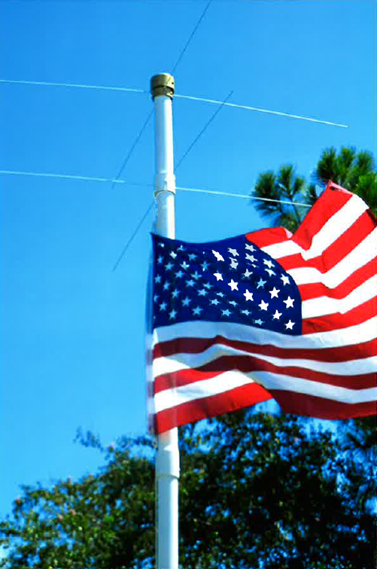
They also have a lot of practical information about stealth and compromise antennas they’ve used and tested. It’s contained in the Villages Antenna Guide. The A-F grade ratings for the antenna configurations are subjective, but they will provide a basis for comparison. Flagpole Verticals in The Villages provides details on the construction and installation of these antennas, with a helpful list of references and guidance on extending coverage beyond 40 meters.
Editor’s Note: Check out this DX Engineering article from October 2016 on “Building a Flagpole Antenna in an HOA” about a resident of The Villages who got creative…and got on the air with the support of DX Engineering (see photo below from the article’s featured antenna builder).
Sometimes administrators can be surprisingly supportive. The retirement community of SaddleBrooke in Arizona has an amateur radio club that operates a full HF station from its clubhouse, including a crank-up tower. SaddleBrooke Radio Club (SVARA) uses this setup to support emergency communications and other activities.
These are just two examples. While retirement homes aren’t generally marketed as having dedicated ham radio facilities, many communities cater to a range of hobbies and activities. You can find ham radio clubs in assisted-living facilities or retirement communities by doing an internet search for “retirement communities with ham radio clubs” or looking under the activities section of their general listings. Martin, AA6E, has compiled a short list of ham radio and senior-friendly community links.
Being Radio-Active
Operating amateur radio in an assisted-living or retirement community isn’t just possible—it can thrive. With today’s compact rigs, stealth antennas, accessibility tools, and remote-operating capabilities, hams can stay active in the hobby well into their senior years. Often, communities will accommodate ham radio if a workable plan is presented to those in charge.
Whether it’s checking into a morning net, teaching newcomers, running a loop antenna in the living room, or controlling a powerful remote station from a recliner, senior hams continue to prove that curiosity, creativity, and a good set of headphones make age irrelevant on the airwaves. For many of them, it’s not just a hobby—it’s a lifeline.

