

DX Engineering donates amplifier to make more QSOs possible.
***
Well into its 77th year, the United Nations Amateur Radio Club (UNARC) continues to operate from the UN Headquarters in midtown Manhattan—an employee amenity tucked among far more ordinary facilities like a ping-pong table and a basketball court. Yet behind this modest description lies one of the world’s most distinctive amateur radio stations: 4U1UN.
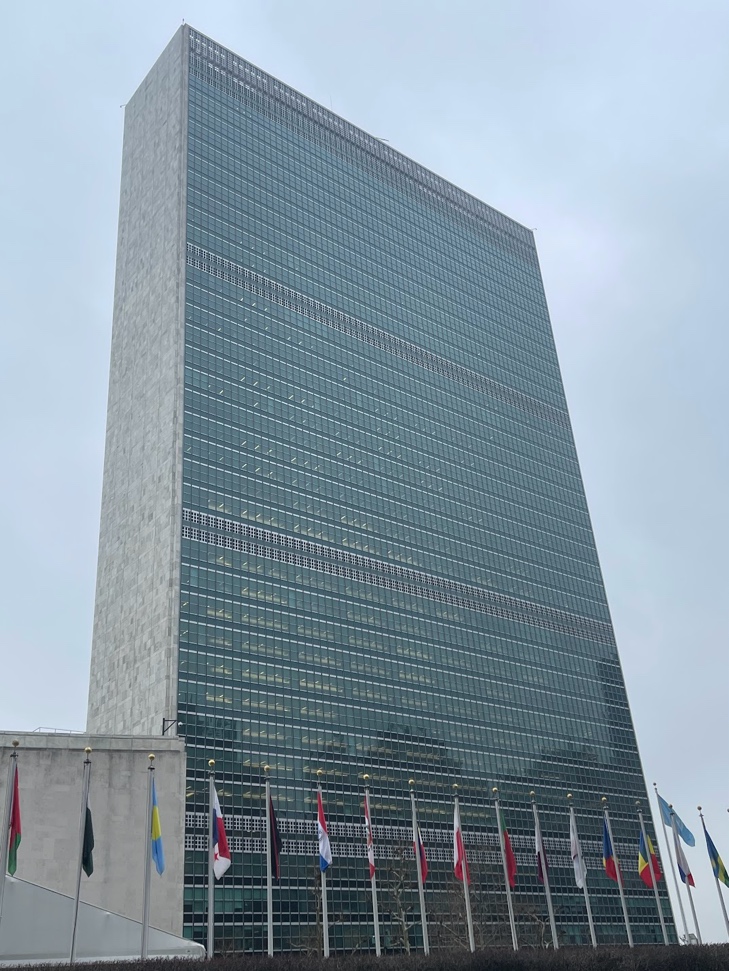
Remote operation has become the norm in recent years, enabled by the club’s robust network infrastructure. A dedicated fiber link provides stable internet connectivity, allowing UNARC members—including UN operators posted abroad—to run the station from afar. The FlexRadio Flex-6600, loaned to the club by FlexRadio and chosen for its reliability and simple network setup, has performed virtually nonstop for more than five years. Its panadapter has proved indispensable for navigating the dense RF noise endemic to Manhattan and the UN campus.
Complementing the transceiver is an efficiently designed amplifier chain. The ACOM 500S—a lightweight, remotely managed solid-state amplifier donated by DX Engineering, integrates seamlessly with the ACOM eBox and ACOM-06ATtuner/switch. Operators can select any of the three primary antennas without additional switching hardware. This combination has powered thousands of recent QSOs and has enabled increased activity on the low bands, where demand for the 4U1UN DXCC entity remains especially high.
Antennas Above a 500-Foot Icon
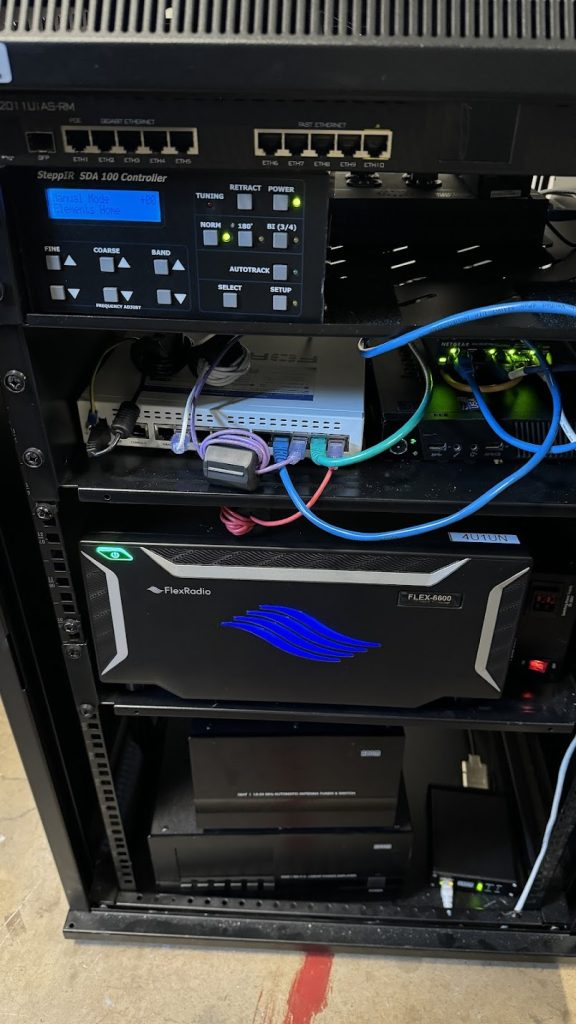
Perched atop the UN Headquarters tower, the station’s antennas brave fierce winds, winter storms, and the occasional hurricane. Each maintenance trip requires coordination across multiple UN departments—a natural complication when working in a secure building. Still, regular roof visits keep the equipment and antennas in top shape.
HF & Low-Band Antennas
Alpha Delta DX-LB Trapped Dipole (160/80/40M): This antenna was selected both for its rugged construction and because its compact design fits within the limited rooftop space available at UN Headquarters. A full-size 160M dipole could not be accommodated, so a trapped dipole provided the ideal alternative. The DX-LB is supplied with heavy-duty Alpha Delta End Insulators (ALF-DELTA-CIN) made from UV- and RF-resistant Deltalloy, an essential durability feature given the extreme winds atop a 500-foot building.
The dipole is installed in an inverted-V configuration on a Rohn 9H50 Telescoping Mast, with its uppermost, thinnest section removed. Constructed of galvanized steel for corrosion resistance, the mast collapses into a compact size, making transport to the roof significantly easier. It is guyed with 5mm Mastrant-P Rope (MP05100)—a lightweight, UV-protected, nonconductive synthetic line known for its strength, abrasion resistance, and long service life, with no impact on antenna performance.
The SteppIR BigIR vertical antenna covers 40-6M and uses band-specific tuned radials. Its greatest advantage is multiband capability within the tight footprint available on the UN rooftop. Band changes are controlled remotely through a simple web-browser interface. The BigIR has operated continuously and without failure for the past seven years.
VHF & Beacon Antennas
For 6 meters, a three-element M2 6M3SS Beam was recently added to the station. This antenna was selected for its compact size, light weight, and relatively broad radiation pattern—an important advantage since the current installation cannot accommodate a rotator. A three-element design provides meaningful gain without the narrow beam-width of larger arrays.
The antenna is mounted horizontally on the side of the Rohn mast in a perpendicular configuration, using DX Engineering Genius Clamps (DXE-SSGC-2P). These brackets are simple, durable, and adaptable to many mounting needs, and are made from 1/8-inch-thick 304 stainless steel for long-term corrosion resistance.
The club’s 6-meter capability received a major boost when the M2 beam was installed—a project spearheaded by Metin, K2ECE, the current club president. Nearly 2,000 QSOs across 37 DXCC entities were logged in its first season. With the amplifier now online, even stronger results are expected.
Meanwhile, the Northern California DX Foundation (NCDXF) Beacon continues its mission of contributing to global real-time propagation monitoring.
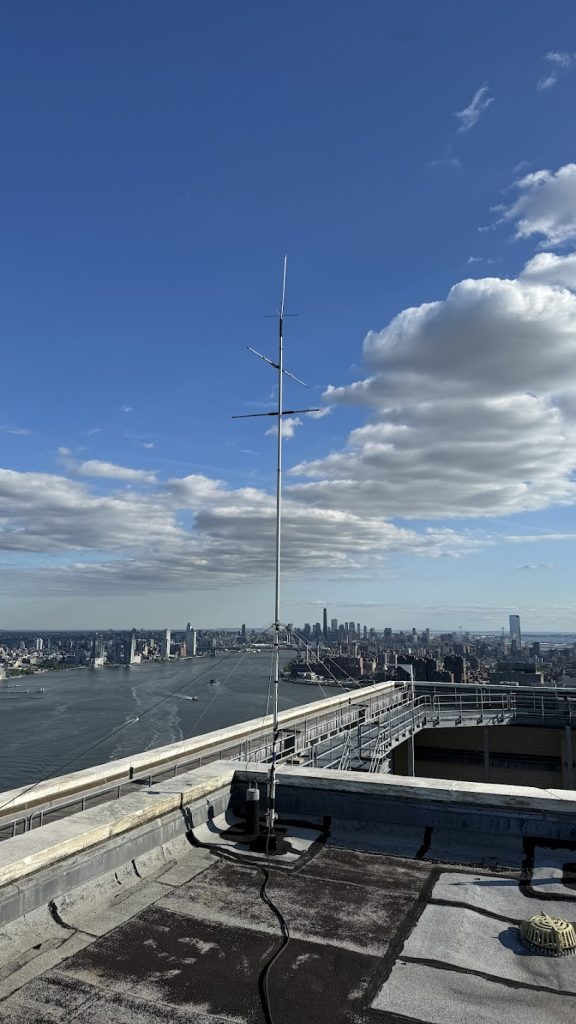
The Cushcraft MA5VA 5-band antenna has been serving the long-running NCDXF 4U1UN/B beacon. A failed beacon transmitter was recently replaced with an Icom IC-7200 provided by NCDXF. The radio is co-located with the UNARC rack on the 42nd floor.
The Challenges of Operating from the Heart of Manhattan
The most stubborn obstacle at 4U1UN is not paperwork—it’s noise. Urban RF interference regularly sits at S5–S7, easing only slightly on weekends. With countless electronic devices in and around the skyscraper, weak callers often struggle to rise above the noise floor. New AI-based filtering solutions, which have shown promising S/N improvements in early trials, are now being evaluated to help level the playing field for distant stations, especially in Asia.

Another ongoing challenge is antenna authorization. Any change to rooftop equipment must pass through several layers of review. Securing approval for the new low-band inverted-V required persistence and patient diplomacy, ultimately achieved through the efforts of K2ECE. The payoff has been significant: renewed activity on 160 and 80 meters, where 4U1UN is among the most sought-after multipliers.
A Look Back: From 1948 to the Present
The club’s story began in May 1948, when the original station, K2UN, first went on the air from UN Headquarters in New York. Three decades later, in 1978, the secretary-general authorized a new callsign—4U1UN. This milestone was largely secured through the work of Max De Henseler, HB9RS (SK 2013), then serving as the UN’s chief cartographer. Max also logged the first-ever 4U1UN QSO after the DXCC status change.
Following his retirement to Switzerland in 1989, the club carried on through cycles of high activity and quiet periods. Special event operations marked major UN anniversaries, including 4U70UN, 4U75UN, and various contest efforts. A memorable activation in 2015 saw a nine-operator team record about 6,000 QSOs from the UNHQ North Lawn Garden.
The next major revitalization arrived in 2018, when volunteers installed new equipment and a SteppIR BigIR vertical. Activity surged. In fact, in the seven years since that 2018 upgrade, more contacts have been logged than in all previous decades combined.
A notable highlight followed in 2020, when Nobel laureate Dr. Joe Taylor, K1JT, co-developer of FT8, visited the station and made the first-ever FT8 QSO from UN Headquarters. Shortly afterward, club members and guests activated 4U1UN in the ARRL DX SSB contest.
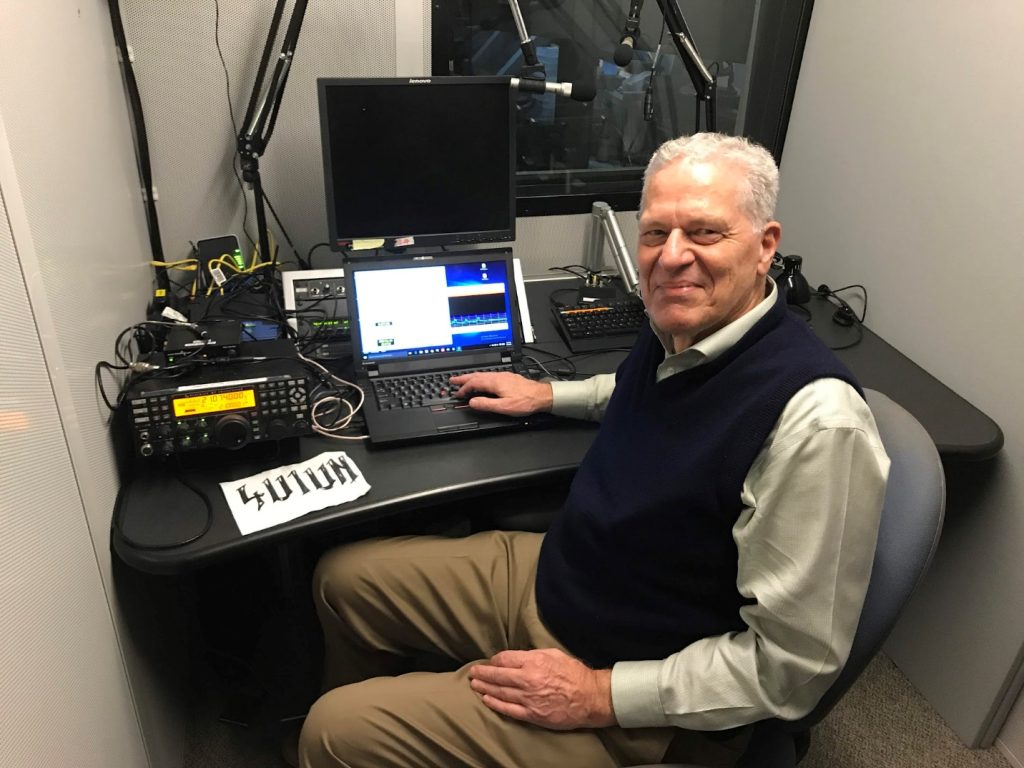
That same year, the Yasme Foundation recognized the leadership behind 4U1UN’s resurgence. The Yasme Excellence Award was presented to James Sarté, K2QI (President Emeritus) and this article’s author, KO8SCA, acknowledging our persistence and strategic vision.
Recognition & Impact
The results of sustained activity are visible in global ranking metrics. On Club Log’s Most Wanted list, 4U1UN has climbed dramatically—from #27 in 2018 to #99 in 2025, nearly meeting the long-standing goal of moving out of the top-100 most-wanted DXCCs. With new antennas, expanded low-band operation, and better noise mitigation underway, the club expects further improvements.
The reliability of QSL and logging operations has played no small part. Since 2004, Herbert Aeby, HB9BOU, has served as the volunteer QSL manager, handling direct requests, Club Log updates, LoTW uploads, and global inquiries.
For a deeper historical archive, including rare photos and documentation, visit the 4U1UN website and 4U1UN Facebook page.

