

Why do some of your competitors always seem to know what band to be on? Where do they get those additional QSOs and multipliers from? How come their rate sheet shows an overall better average than yours, hour after hour? How do you move beyond just copying call signs and putting them in the log? The answer of course is, once again, experience.
The first dozen Contesting 101 installments focused primarily on the nuts and bolts of contest operating. Skills such as copying call signs, the importance of running, S&P techniques, dealing with QRM, and so forth were discussed. There is a level of operating beyond the mechanics of copying call signs accurately and putting them into the log.
It’s kind of like driving a car.
At first, all of your attention is focused on operating the vehicle. You have to learn how to operate the vehicle properly and learn the feel of the road. After some time and experience behind the wheel, you begin to have more time to pay attention to other things. (No, I don’t mean texting on your cell phone…)
Contest operating requires a great amount of attention and focus. In the beginning, copying call signs correctly and putting them into the log accurately can use up most of the attention and “mental horsepower” that you have available. All of your energy is spent trying to focus on the signals that you hear.
After some time and several thousand contest QSOs under your belt, you reach a point where copying call signs becomes somewhat mechanical, and you can start to look at the contest from a higher level.
The Contest Meta-View
It is important to develop the ability to see the contest from different angles and consider your operating strategy from both a short-term and long-term perspective. The bands are in a constant state of change during the course of a contest. You have to learn to keep reevaluating what is happening and adjust your operating approach as necessary. Good questions to ask during the contest include the following:
- How long have I been on this band?
- How is the rate in the last 10 minutes and the last hour?
- How is the multiplier count on this band, and all other bands?
- Might there be other bands opening at this time?
- Are the signals from the main population centers strong on this band?
- When was the last time I made an aggressive S&P pass on this band?
- What are the chances that I have worked most of the stations on this band?
- What would be the optimum break period? (For contests that have them.)
- Should I be trying a different beam heading or long path or skew path right now?
- How might the propagation forecast affect my band strategy?
- Where and when should I look for that rare section or country multiplier?
- Do I need a multiplier that just called in on another band?
- If I were to move a mult, what frequency would I move them to?
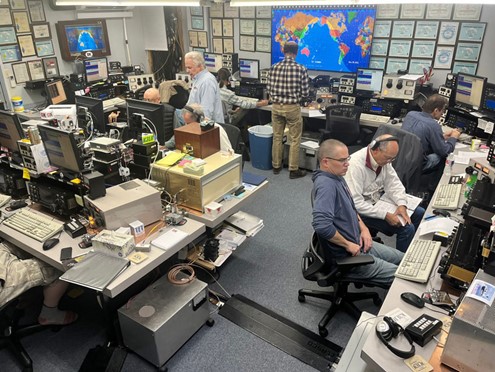
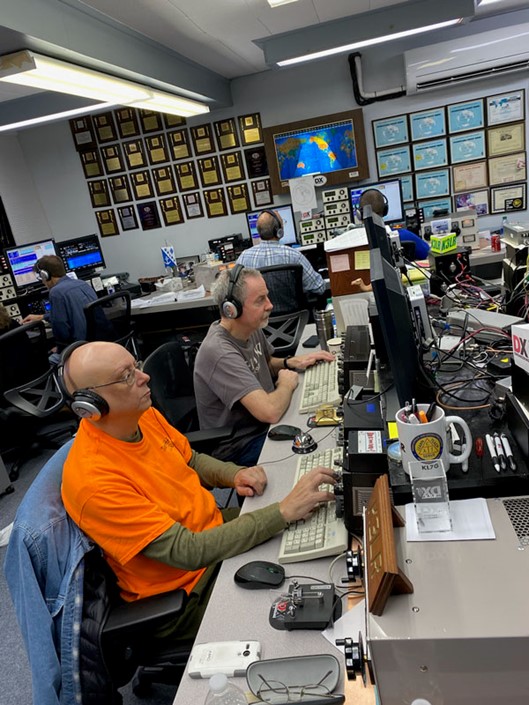
Obviously, there are a lot of items to consider while keeping busy copying call signs. With operating experience, you gain the ability to spend more time considering some of the questions above while putting call signs into the log at a good rate. As your experience with a particular contest grows, you’ll begin to understand what issues are most important for that contest. For example, you don’t move mults (or even QSOs) in Sweepstakes, so mult moving questions are not relevant in that contest.
On the other hand, knowing where and when to begin searching for a VY1 is a very important issue in SS. Every contest presents its own unique set of challenges, and different strategies are required for different situations.
Keeping an Eye on the Gear
Another important requirement besides copying call signs is learning to keep an eye on the station gear. Going back to the automobile analogy, you have to watch your temperature and fuel gauges, pay attention to your speedometer, and make sure no warning indicators are lit. Likewise with your contest station, you have to keep an eye on different parameters and make sure that everything is running as it is supposed to.
Some of the things we want to keep an eye on include:
- VFOs, memories, and other frequency determining gear
- Microphone ALC level and compression settings
- CW keying waveform on a monitor scope (especially when using an amplifier)
- Power output and SWR meters
- Amplifier voltage and current meters, status indicators and temperature
- Antenna rotator indicators
- Time clock, especially in contests with an off-time, like NAQP and Sweepstakes
- Receiver settings such as RF gain, volume, CW pitch, pass-band centering
- Antenna selection indicators, including receive antenna selection
- Headphone, keyer, mic audio, and SO2R switching indicators
- Software status and reports such as rate, mults, points per QSO, etc.
Station monitoring has other benefits besides keeping us legal. Proper monitoring can prevent damage to equipment and help to ensure long-term reliability of station components. It can also help with troubleshooting when something goes wrong. Another benefit is the feeling of confidence that comes from the knowledge that every component is operating at peak efficiency.
The Contest Postmortem
It takes time and experience to develop a sense of where to be…and when. It’s clear that there are many things to think about besides just copying call signs correctly. A good place to develop a strategy for a specific contest is to review your previous efforts in that contest. I try to review my logs from previous years to see if there is anything I can do better next time.
One thing that I have found helpful is to create a brief “postmortem” writeup soon after the contest is over. I write down my perception of events and try to take note of anything that I think could use improvement. It might be an operating strategy decision such as “be sure to check 15 meters at 2100z,” or a station design improvement such as “make the Beverage indicator lights blink so I don’t forget to switch back to the transmit antenna when on the high bands.”
There is a wealth of information available in your memory immediately following a contest. Try to capture some of that information after your next effort and see if you can’t find some ways to improve in the next event.
That’s all for this installment. One final thought—don’t forget to submit your log to the sponsor, no matter how many QSOs are in the log. It’s a good habit to get into, and you never know when you might qualify for an award. It also improves the log checking potential accuracy.
Please send any questions or comments to me at k4ro@k4ro.net.
73

